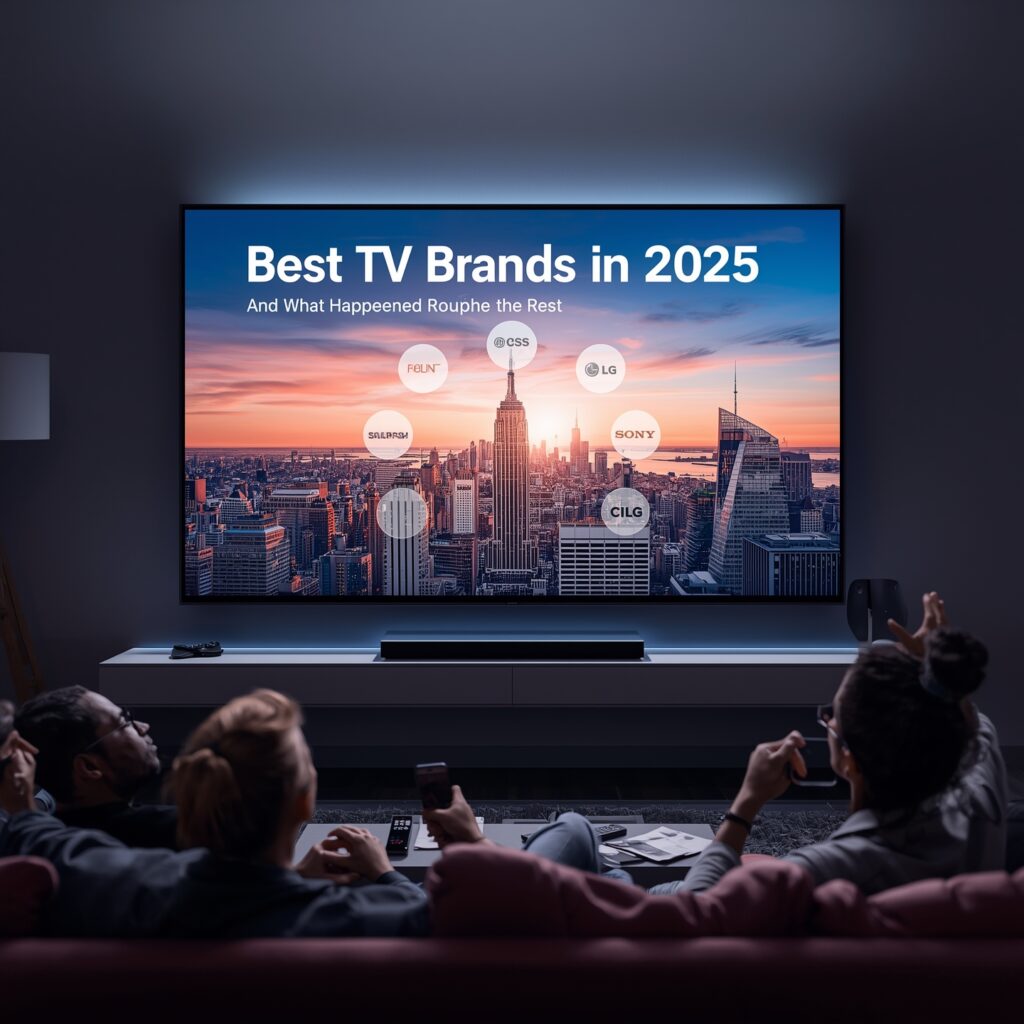

I’m Caleb Denison with Digital Trends. If you’re in the market for a new TV in 2025, you’re probably overwhelmed by brand names, acronyms, and ever-evolving display tech. I put together this guide to help you cut through the noise: which TV brands deserve your attention right now, what makes them stand out, and what happened to many once-great names that now only appear on budget shelves or under new ownership.
How I picked the brands on this list
Rather than ranking brands in a strict order (that gets subjective fast), I judged them by:
- Price-to-performance ratio — the value you actually get for the money.
- Feature sets — from smart TV platforms to unique hardware pieces like The Frame or One Connect boxes.
- Innovation — who’s pushing the industry forward with new display technologies or practical refinements.
Samsung
Samsung has been a dominant force in TVs for well over a decade. They transformed the market with aggressive marketing, new naming conventions (hello, QLED), and ambitious hardware concepts like The Frame and the One Connect Box. Samsung was also one of the companies that pushed ultra-slim designs and a smartphone-like smart TV OS, which let them pare remotes down to just a few buttons and even introduce self-charging remotes.
Technically, Samsung was slow to fully embrace OLED, but today they manufacture both OLED and advanced LED/QLED sets, including Mini-LED models. Recently, Samsung doubled down on practical innovation — notably anti-glare technologies for premium screens — which keeps their top-tier sets highly competitive for bright-room viewing.
LG
LG is synonymous with OLED. Their watershed moment came with the first 55-inch OLED about a decade ago, and since then LG has been the brand most associated with the advantages of OLED: perfect blacks, excellent contrast, and superb viewing angles. Their leadership in OLED forced other manufacturers to respond, pushing overall picture quality forward across the industry.
LG also makes LCD-based TVs branded as QNED. Those haven’t eclipsed OLED in popularity, but they represent LG’s attempt to compete across the performance and price spectrum.
Sony
Sony went through a strategic shift as Asian competitors gained market share: instead of chasing volume, they doubled down on premium performance. If you grew up with Sony’s Trinitron and WEGA lines, you know the brand’s pedigree. Today Sony focuses on high-end mini-LED and OLED TVs, and has leaned heavily on mini-LED backlighting to deliver superior contrast control in very bright rooms.
Panasonic
Panasonic was absent from the U.S. TV market for about ten years, but it quietly returned in 2024 with a small but impressive lineup: multiple OLEDs, a mini-LED model, and a straightforward LED option. Panasonic has long made excellent TVs in other markets, and its return to North America is a welcome reminder that some legacy brands still have premium offerings worth considering.
TCL
TCL’s rise has been fast and unmistakable. The 2018 Six-Series marked its arrival into the premium-value tier, proving you no longer needed to spend thousands to get excellent picture quality. TCL favors QLED and Mini-LED implementations and is one of the best examples of aggressive price-to-performance: solid TVs, impressive picture quality for the price, and expanding market share in North America.
Hisense
Hisense has quietly become one of the most influential players. Their growth hasn’t always been meteoric, but they’ve adapted fast. Thanks in part to leadership in the U.S. market that pushed for stronger models to be sold domestically, Hisense has introduced a wide range of well-priced TVs with technologies like ULED (their marketing name for quantum-dot-enhanced LCDs), Mini-LED backlights, and even experimental RGB Mini-LED in gigantic flagship displays.
If there’s a brand lighting a fire under the industry on price-to-performance, it’s Hisense.
Better abroad than in the U.S.: Philips (TP Vision)
Philips is an important case of brand differences by region. In the U.K. and Europe, Philips TVs are engineered and distributed by TP Vision and often represent high-quality designs with compelling features. In other regions — notably the U.S. — the Philips name has been licensed to other manufacturers (like Funai), and those models tend to sit in a lower tier.
Rule of thumb: a Philips TV bought in Europe or the U.K. is not necessarily the same product you’ll find under the Philips badge in the U.S.
Vizio’s slip and what it means
Vizio was once a darling for delivering outstanding value. Lately, though, it feels like Vizio lost its way. Internal tensions between engineering ambitions and corporate direction, combined with a SmartCast platform that never won everyone over, left Vizio vulnerable to the likes of TCL and Hisense. Now owned by Walmart, the brand still produces sets, but its long-term product strategy and quality trajectory are less certain.
Honorable mentions: Roku and Amazon
Both Roku and Amazon badge TVs built by OEMs. The best models from each are solid — especially if you want a familiar smart platform baked into your TV — so they deserve consideration even if they’re not on this “best brands” list in the traditional sense.
What happened to the classic big names?
Brands like Toshiba, JVC, Sharp, RCA, Hitachi, and Sanyo were once household names in television. Over the past 15–30 years the market consolidated dramatically. The short version of what happened:
- Financial challenges and shifting consumer demand reduced the scale and profitability of many legacy manufacturers.
- Brand rights and intellectual property were sold or licensed to larger global manufacturers and holding companies.
- The modern products carrying those familiar badges are often Tier-3, value-focused sets built by contract manufacturers — not the premium products those names once implied.
Examples worth knowing:
- Toshiba — now owned by Hisense.
- JVC — owned by AmTRAN (a company with ties to past Vizio manufacturing).
- Sharp — sold to Hisense and then Foxconn; Sharp has been slowly buying back rights and has tried to re-enter some markets.
- RCA — licensed to Curtis International and Technicolor for certain regions.
- Hitachi — licensed to Vestel in Europe and to Hisense in Australia.
- Sanyo — briefly with Panasonic, ultimately wound up under Hisense’s umbrella.
Look at that list and you’ll see a recurring name: Hisense. Buying or licensing legacy brands has been one way modern manufacturers scale distribution quickly — and it explains why a lot of budget TVs today share technologies, panels, or software even when they carry different legacy badges.
“Times must and always do change, my friend.”
Quick primer: OLED vs QLED vs Mini-LED
Short and practical:
- OLED — self-emissive pixels, exceptional black levels and contrast, great viewing angles. Often the best-looking picture, especially in dark-room viewing.
- QLED / quantum-dot LCD — an LCD screen with a quantum-dot layer to boost color and brightness. Excellent in bright rooms and for HDR peak brightness.
- Mini-LED — a backlight technology that uses many more, smaller LEDs for tighter local dimming and improved contrast on LED/LCD TVs.
Manufacturers mix and match these approaches (QD-OLED, QLED + Mini-LED, etc.) to chase specific performance goals and price points.
Final thoughts and what to watch for
The TV landscape is changing faster than it used to. Samsung and LG remain powerhouses, Sony continues to own a premium niche, and new challengers like TCL and Hisense have shown that superior price-to-performance can completely reshape market share. Panasonic’s return to the U.S. is a reminder that strong legacy brands can come back with compelling products, while many old names remain alive only as licensed labels.
If you’re shopping: decide what matters most — perfect blacks and cinematic image (OLED), max brightness and anti-glare performance (high-end LCD/QLED with Mini-LED), or the best value for a budget-conscious living room (TCL, Hisense, and certain Roku/Amazon-badged models).
What brand do you love — and which one do you love to hate? Let me know which TVs you’re watching this year and why. Times change, and I can’t wait to see who’s on top in 2026.