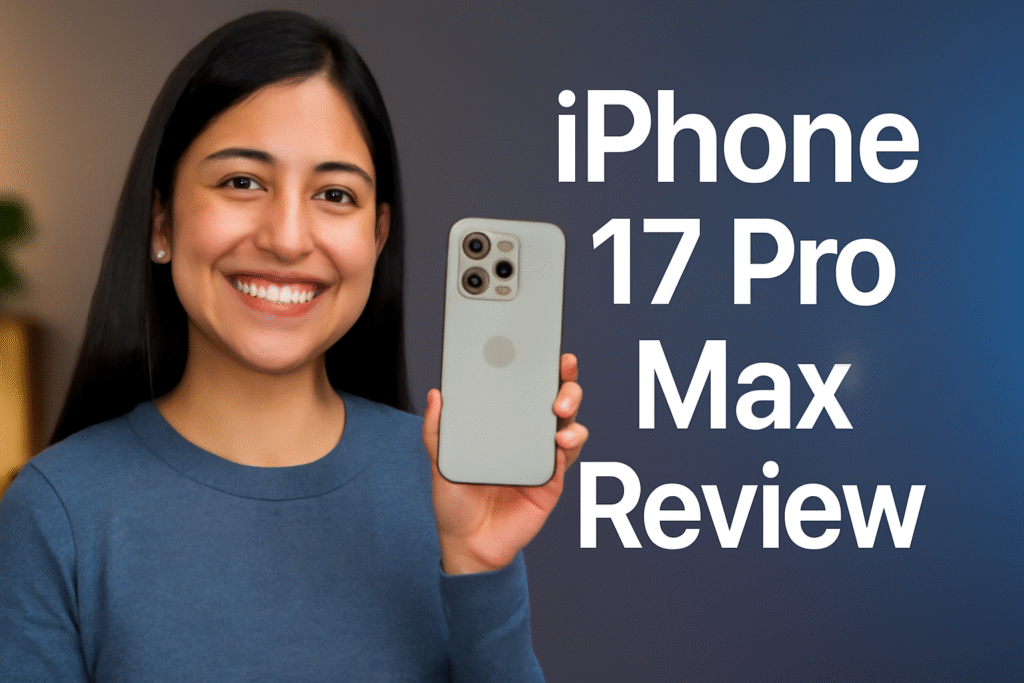

Hi — I’m Pratima from GadgetByte. After two weeks with the iPhone 17 Pro and the iPhone 17 Pro Max, here’s my hands-on verdict: what’s genuinely new, what’s a sensible refinement, and where Apple still lags behind the competition. I’ve tested design, display, battery, performance, cameras, and the new iOS 26 to bring you a clear picture of whether these Pro models are worth upgrading to.
Quick takeaway
- The new design is refreshing and very comfortable in hand.
- Battery life and thermal performance have improved noticeably.
- Cameras are refined — selfie and telephoto see the biggest practical gains — but flagship Chinese phones remain ahead in sensor innovation.
- Software (iOS 26) is more customizable and stable, but Apple’s AI promise feels under-delivered.
- I’d skip the iPhone Air due to too many compromises; the base iPhone 17 is my favorite overall.
Design: a bold, familiar refresh
The Pro models get a fresh look this year. The back is mostly aluminum with a glass strip over the wireless charging coil, and the rounded edges bring back a feel that reminded me of the iPhone 6 era — smooth and very comfortable to hold.
Apple switched from titanium frames back to aluminum. That surprised a lot of people: titanium is stronger and more scratch-resistant, but Apple says aluminum helps with heat dissipation. I think that’s a fair trade-off given the improved thermals (more on that below).
One important new material is Ceramic Shield 2 on the back. Apple claims better drop resistance and three times the scratch resistance. In stress tests, the 17 series scratched at higher levels than many competitors. In real life, I dropped my 17 Pro Max on concrete the day I bought it and only got a few scuffs — the display stayed pristine even without a screen protector.
“Scratch Gate”
That said, there are reports — and I noticed it on my unit — of the camera-module coating chipping on certain colors (notably orange and blue). Reviewers have nicknamed this issue “Scratch Gate.” It’s cosmetic, but worth knowing if you’re picky about finish durability.
Display: mostly the same, with two useful upgrades
Internally the display hasn’t undergone a massive overhaul — last year’s panel was already excellent in touch response, haptics, speakers, and color accuracy. The two notable changes are:
- Anti-reflective glass: It improves visibility in direct sunlight, though I still find Samsung’s anti-reflective coatings a touch better. The trade-off: the 17 Pro Max can look a bit dimmer than the 16 Pro Max, likely due to this extra layer.
- PWM dimming toggle: You can now turn off PWM dimming entirely. If you’re sensitive to low-frequency flicker, disabling PWM dramatically reduces eye discomfort and headaches at low brightness.
One caveat: Apple’s PWM solution still leans toward low-to-mid frequency bands, which can introduce slight color shifts and reduced smoothness at low brightness when PWM is enabled. Many Chinese brands have adopted high-frequency PWM to avoid these issues; Apple (and Samsung, its OLED supplier) seem hesitant to change course yet.
Battery and charging: better endurance, moderate charging upgrades
Apple stuck with conventional lithium-ion battery chemistry while many Chinese manufacturers are using large silicon carbon cells. Despite that, thanks to optimization and a slightly larger battery this generation, battery life on the 17 Pro Max is about 10–15% better than my 16 Pro Max.
- Heavy use screen-on-time: ~8–9 hours (17 Pro Max) → roughly a day and a half of use.
- Smaller 17 Pro: ~7–8 hours of screen-on-time → reliable full-day battery.
Charging is improved if you buy Apple’s new 40W AVS charger: expect roughly 50% in 20 minutes. However, if you already have a 30W or 65W PD charger from brands like Ugreen or Anker, the real-world difference isn’t huge — you won’t necessarily need to upgrade chargers unless you want the absolute fastest Apple-supported speeds.
Performance and cooling: incremental chip gains, big thermal wins
The A19 Pro is not a dramatic generational leap over the A18 Pro for everyday tasks — you likely won’t notice day-to-day. The real win is sustained performance: Apple finally added a vapor chamber cooling system (previously phones used graphite sheets). That modern cooling solution reduces temperatures by about 2–4°C under heavy gaming compared to the 16 Pro Max and prevents screen dimming during long play sessions. This pays off with better sustained FPS, cooler components, and potentially improved long-term hardware health.
iOS 26: more customizable, more stable — but AI is missing
iOS 26 has significantly improved since launch. The “better release” updates over the past few months fixed bugs and polished the UI. For the first time, iOS feels genuinely customizable in ways that used to be Android-only:
- Set MP3s as ringtones.
- Built-in call recording.
- Shoot simultaneous front and back videos.
That said, Apple’s big AI promises remain underwhelming. A year after promising a smarter, more personalized core, Apple didn’t highlight meaningful AI features during the iPhone 17 keynote. I still expect Apple to roll out more on-device intelligence in time, but right now Google and Samsung feel further ahead in practical AI features.
“AI for the rest of us”
Apple pitched AI as a headline feature before — but in this generation, that promise remains largely unrealized.
Cameras: solid video leader, modest photographic upgrades
Camera upgrades this year are pragmatic rather than revolutionary. Two areas stand out:
Selfie camera
The front camera is now an 18MP sensor with a larger square capture mode and wider field of view. For vloggers and group selfies, the square mode is genuinely handy — no need to rotate the phone to fit everyone in. Even in regular portrait orientation, selfies show better detail and a wider framing compared to the 16 Pro Max.
Telephoto / zoom
The telephoto moved from a 12MP 5x lens to a 48MP 4x lens (shooting 24MP by default). Although the nominal 4x focal length sounds like a step back from 5x, the larger sensor and higher resolution result in slightly better detail and more practical 100mm portraits — you don’t need to stand as far back. Portrait edge detection and detail are improved.
Main and ultra-wide
Apple kept the same main and ultra-wide sensors as last year, but image processing improved highlights and shadow handling, and lens glare at night is reduced. One of Apple’s enduring strengths is consistent color reproduction across lenses — something the iPhone still does better than most.
Overall photography grade: A−. It’s excellent for most users, but Chinese flagships like the Xiaomi 15 Ultra, Vivo X200 Pro, and upcoming models with larger sensors and collaborations with camera brands (e.g., Zeiss, Leica) are pushing mobile photography forward faster.
Video
This is where Apple still leads. ProRes video remains superb for professional workflows and color grading. Portrait video mode is polished, lens switching while recording is seamless, and front+rear simultaneous recording works well. If you make videos and care about quality and editability, the iPhone 17 Pro lineup is hard to beat.
Who should upgrade?
- Upgrade if you want a fresh design, better sustained gaming thermals, improved battery life, or superior video capabilities.
- Consider skipping if you have a 16 Pro/Pro Max and don’t care about the selfie or cooling improvements — the A19 Pro isn’t a major leap for daily tasks.
- Avoid the iPhone Air if you want balanced performance and camera quality — it compromises too much for slimness.
Final verdict
The iPhone 17 Pro and 17 Pro Max will sell in the millions — Apple’s ecosystem, brand trust, and reliability keep people upgrading. The refreshed design and the upgraded selfie camera are meaningful wins. But I’m a bit disappointed overall: aside from the design and some pragmatic improvements (battery, cooling, selfie), there aren’t many bold new features. Camera upgrades are iterative rather than disruptive, and Apple’s AI promise still feels like a road not yet traveled.
If you value video, color consistency, a refined OS, and improved thermals, the 17 Pro series is an excellent pick. If you were expecting sweeping camera sensor changes or a major AI-driven experience this generation, this year may feel conservative.